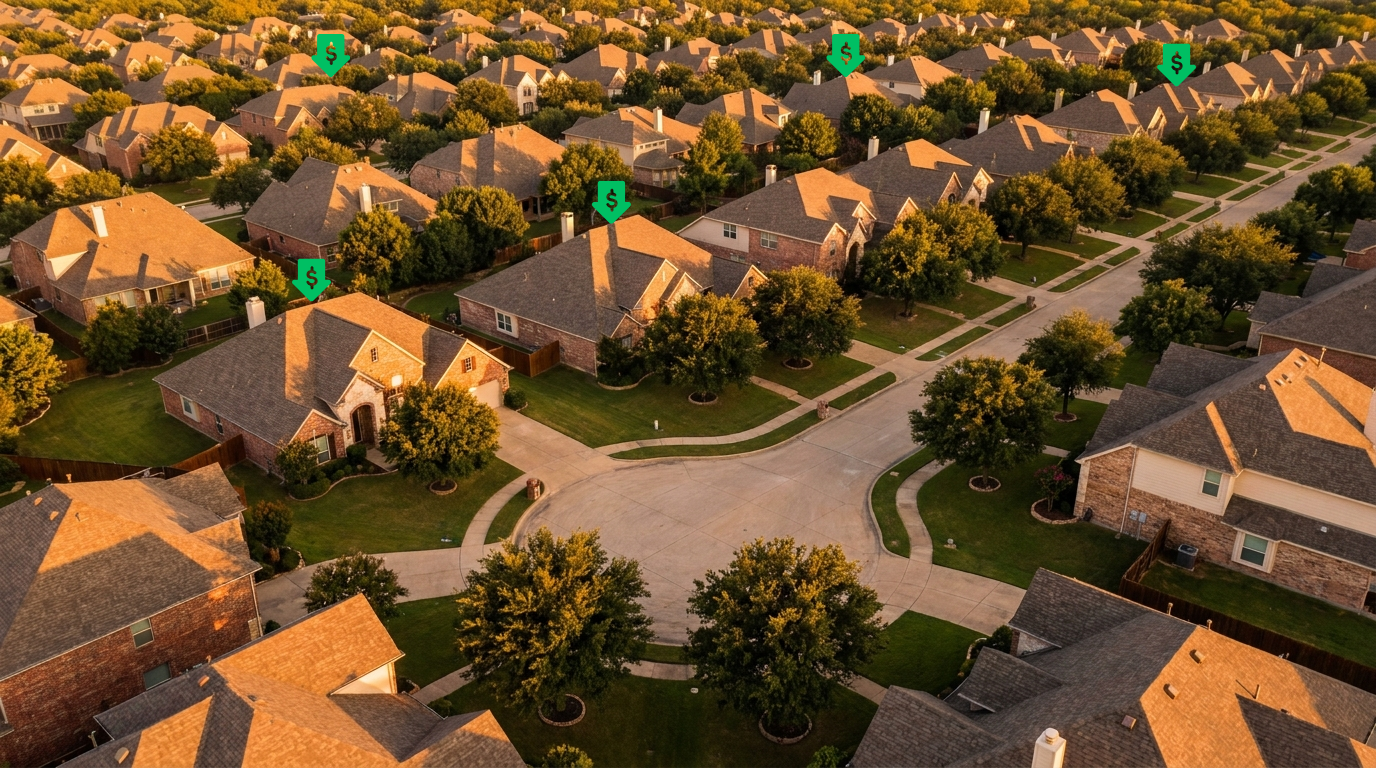
The same process agents have relied on for decades is available to any Texas seller who knows where to look. Here is exactly how to build a CMA, find the right comps, adjust for differences, and calculate a price range you can defend.
- In this articleWhat is a CMA and why does it matter
- How to pull the right comparable sales
- How to adjust for differences between your home and the comps
- How to calculate your price range
- Why the first two weeks are the most important
- What overpricing actually costs you
- How Waymark handles pricing for Texas sellers
Pricing your home without an agent in Texas is completely doable, and the process you will use is the same one agents have relied on for decades. It is called a Comparative Market Analysis, or CMA. You can create one yourself using real market data, and if you do it correctly, you will arrive at a price that holds up through showings, offers, and the subsequent appraisal.
Getting it right matters more than most sellers expect. According to the Texas Real Estate Research Center at Texas A&M University, the median price cut Texas sellers made in January 2026 was $19,000, which was about 5 percent off their original list price. Those were not sellers who priced too low. Those were sellers who started too high, stayed on the market too long, and had to lower their price after losing their best buyers. A price that holds up from the start keeps you out of that situation. Pricing is the single decision that determines which outcome you are headed toward.
This article will walk you through exactly how to build your own CMA in Texas, find the right comps, adjust for the differences between your home and those comps, and calculate a price range you can defend.
What Is a CMA, and Why Does It Matter?
A Comparative Market Analysis is the structured process agents use to determine a home's list price, and it is the same process any Texas seller can use on their own.
At its core, a CMA is a clear comparison of recently sold homes near yours, with adjustments for how your home differs from those properties. It is based on real sales data that the market supports. The data used in a CMA includes recent sales, square footage, number of bedrooms and bathrooms, lot size, location within the neighborhood, and the condition of the home.
Agents create a CMA for every listing because no lender, appraiser, or experienced buyer's agent will take a price seriously unless it is backed by closed-sale data. In Texas, that matters even more because of how the TREC contract is structured. Once a buyer goes under contract, they enter an option period during which their lender will order an independent appraisal. If that appraisal comes in below your list price, the buyer can use it as grounds to renegotiate or walk away entirely. A list price built on solid, recent comparable sales is your most reliable protection against that outcome.
Important: Have you been relying on the Zillow Zestimate or Redfin Estimate to price your home? Those automated estimates are based on public records that are often incomplete and sometimes outdated by months. Texas is a non-disclosure state, which means sale prices are not always recorded accurately in public data. Agents pull actual closed-sale prices directly from the MLS. That is the data your CMA should rest on.
How to Pull the Right Comparable Sales
Finding the right comps is the foundation of accurate pricing. You do not need access to a private MLS to do this work, but you do need discipline to filter out irrelevant information.
Use the right filters on public portals
Use Zillow or Realtor.com. Both platforms allow you to set specific filters, and using these correctly is what separates a reliable price from a guess. In the filter settings, change the status from "active" or "for sale" to "sold." This is the most important first step. Then narrow the time frame to sold within the last 90 days. In Texas markets where days on market are extending, looking back further than 90 days risks including data from a different market environment. If you are in a rural area with very few recent sales, you can extend to six months, though the data will be less current.
Match square footage and bedroom count
Filter for square footage within 10 to 15 percent of your home's living area. If your home is 2,100 square feet, your comps should fall between roughly 1,800 and 2,400 square feet. After that, filter for bedroom and bathroom count within one of your home's count. A three-bedroom, two-bath home typically attracts a different buyer than a four-bedroom, two-and-a-half-bath home on the same block, even when they are similar in size.
Stay within the right geographic boundaries
Try to stay within one mile of your home when possible, and keep your comparisons within the same neighborhood or school district. This matters significantly across Texas. A seller in Alamo Heights in San Antonio should use comparable sales from within Alamo Heights ISD, not from the wider San Antonio market. The same applies in Austin through ACTRIS, in Houston through HAR, and across Dallas-Fort Worth through NTREIS. Avoid crossing major roads, highways, or school district boundaries unless you have no other choice, because those boundaries often separate different pricing markets.
Target 3 to 5 comparable sales. Fewer than 3 does not give you a clear pattern. More than 5 often dilutes the analysis by pulling in homes that are not truly comparable. If you cannot find 3 strong comps within one mile in the last 90 days, expand your radius by half a mile and your time window to 6 months.
How to Adjust for Differences Between Your Home and the Comps
Once you have your comps, the next step is adjusting for differences between those homes and yours. Two homes with the same square footage and bedroom count can still sell for very different prices depending on condition, updates, lot position, and exact location in the neighborhood.
Condition and updates
A kitchen renovated in the last five years, with new cabinets, countertops, and appliances, adds value compared to an original kitchen. In a Houston suburb where homes are priced between $350,000 and $450,000, an updated kitchen versus an outdated one can mean a $15,000 to $25,000 difference in list price, depending on renovation quality. If a comp recently sold with a renovated kitchen and yours has not been updated, that comp does not reflect what your home is worth. Subtract value from that comp's price before using it in your analysis.
Backing to a busy road or highway
Across Texas, a home backing up to a highway feeder road, commercial property, or busy street typically sells for a lower price per square foot and takes longer to sell than the same home backing to a greenbelt or quiet street. In Katy, two homes on the same street with the same layout can differ by $20,000 to $35,000 based only on what they back up to. If one of your comps backs to a greenbelt and yours does not, adjust that comp's price downward before using it.
Pools
In Texas, a well-kept pool adds value, but how much depends on the market. In Houston and San Antonio, where summers are long and many buyers want pools, a pool in a neighborhood where other homes also have pools might add $20,000 to $30,000. In areas where pools are rare or some buyers see them as a maintenance liability, the added value is lower. Know the standard in your specific neighborhood before assigning a dollar figure.
Lot size
In neighborhoods where most lots fall between a quarter acre and a third of an acre, lot size usually does not make much of a difference. But in areas with larger lots, such as parts of the Hill Country near San Antonio and Austin, or outer suburban areas with acreage, lot size matters and should be factored into your adjustments.
How to Calculate Your Price Range
After you have three to five adjusted comps, calculating a price range is straightforward. The result gives you a defensible starting point for your list price.
Take 3 closed sales. Divide each sale price by its square footage to get the price per square foot. Add those three numbers together, then divide by 3 to get the average. Multiply that average by your home's square footage. That is your baseline.
Comparable sale Sale price Square footage Price per sq ft
Comp 1 · Cedar Park
$410,000
2,000 sq ft
$205.00
Comp 2 · Cedar Park
$395,000
1,900 sq ft
$207.89
Comp 3 · Cedar Park
$422,000
2,050 sq ft
$205.85
Average price per square foot
$206.25
Your home at 1,950 sq ft · baseline value
$401,700
From there, apply the condition and feature differences you found. If your home has an updated kitchen the comps do not, add value to the baseline. If a comp backs to a greenbelt and yours backs to a side street, subtract value. Your final price range should be no more than $15,000 to $20,000 wide at your price level.
The goalLand where qualified buyers respond within the first two weeks of your listing going live. Not the highest number you can justify. The number the market will support.
Why the First Two Weeks on the Market Are the Most Important
The first 14 days after your home goes live are the busiest and most consequential period of your entire listing. What happens during this window largely determines how your sale turns out.
When a new home is listed on SABOR in San Antonio, HAR in Houston, ACTRIS in the Austin area, or NTREIS in Dallas-Fort Worth, it immediately sends email alerts to buyers who have saved searches matching your home's details. These buyers are already in the market. They are ready, and they will act quickly if the price makes sense to them.
A home that books showings and receives serious offers in the first week is doing exactly what a correctly priced listing does. Buyers and their agents can easily recognize a competitive price because they have been watching the market for weeks or months. When multiple buyers are interested, it creates urgency. Urgency leads to full-price or near full-price offers, and sometimes multiple offers that push the final price above asking.
After that two-week window closes, the dynamic shifts. A home that has not generated offers by day 15 or 20 starts to age in the system. New buyers searching the MLS will see how long it has been listed. Their agents will notice too. The listing moves from "new" to "available for a while," and in buyers' minds, that difference carries real weight.
Think of it this wayWould you rather negotiate when two buyers are competing for your home, or when one buyer has been watching your home sit on the market for six weeks and knows no one else has made an offer? That difference comes down entirely to how your home is priced from day one.
What Overpricing Actually Costs You
The real cost of overpricing is fewer showings, weaker offers, and a worse negotiating position the longer your home stays on the market. Most sellers think overpricing is a safe approach, that they can always reduce the price later if needed. But the cost is not just the price drop. It compounds before you ever make that cut.
An overpriced home gets fewer showings from the start because buyer agents filter by price before scheduling tours. A home priced above what the comps support gets passed over by buyers who would have made serious offers at the right number. Fewer showings mean no competing bids. Without competition, the one buyer who does show up knows their position and uses it. They submit a below-list offer, push back on repair requests during the option period, and ask for closing cost concessions, knowing you have no alternatives.
29 days According to TRERC's September 2025 Texas Housing Insight, homes that sold averaged 67 days on market while active unsold listings averaged 96 days. That 29-day gap is where overpriced homes live, carrying costs building and negotiating position weakening every week.
Here is a clear example. A seller in Fort Worth lists at $430,000 while the market data supports $398,000. After 28 days with only three showings and no offers, the price drops to $410,000. The home eventually sells for $393,000, lower than what it likely would have sold for if priced correctly from the start, and the seller also paid three extra weeks of holding costs including mortgage, taxes, utilities, and insurance.
A price reduction also sends a clear signal to every buyer watching the market. It tells them the seller set a number the market rejected, and from that point forward, buyers treat the reduced price as an opening, not a floor.
How Waymark Handles Pricing for Texas Sellers
For sellers who want a professional pricing analysis without paying a listing agent commission, Waymark includes that as part of the service from the very beginning.
Waymark's AI, Aria, builds a pricing analysis using comparable sales data for your address. That analysis is then reviewed by a licensed broker at Marelli Properties, TREC License 639078, before you ever see it. What you receive is a professionally reviewed pricing opinion grounded in current market data.
Waymark serves sellers in San Antonio through SABOR, Houston through HAR, Austin through ACTRIS, and Dallas-Fort Worth through NTREIS, with one flat fee and no listing commission at closing.
Pricing your home correctly in today's Texas market is harder than it was three years ago, and the consequences of getting it wrong are greater. The process described in this article, pulling verified closed sales, matching the right features, adjusting for real differences, and calculating with price-per-square-foot math, is the same basic process professionals use. It takes care and time, but it is absolutely possible for a Texas homeowner willing to work through it step by step.
If you want to see how the pricing analysis works before making any decisions, start here at waymarkre.com.
Get a broker-reviewed pricing analysis for your home.
Aria builds a pricing analysis using comparable sales data for your address. A licensed Texas broker reviews it before you see it. Flat fee from $699. No listing commission at closing.