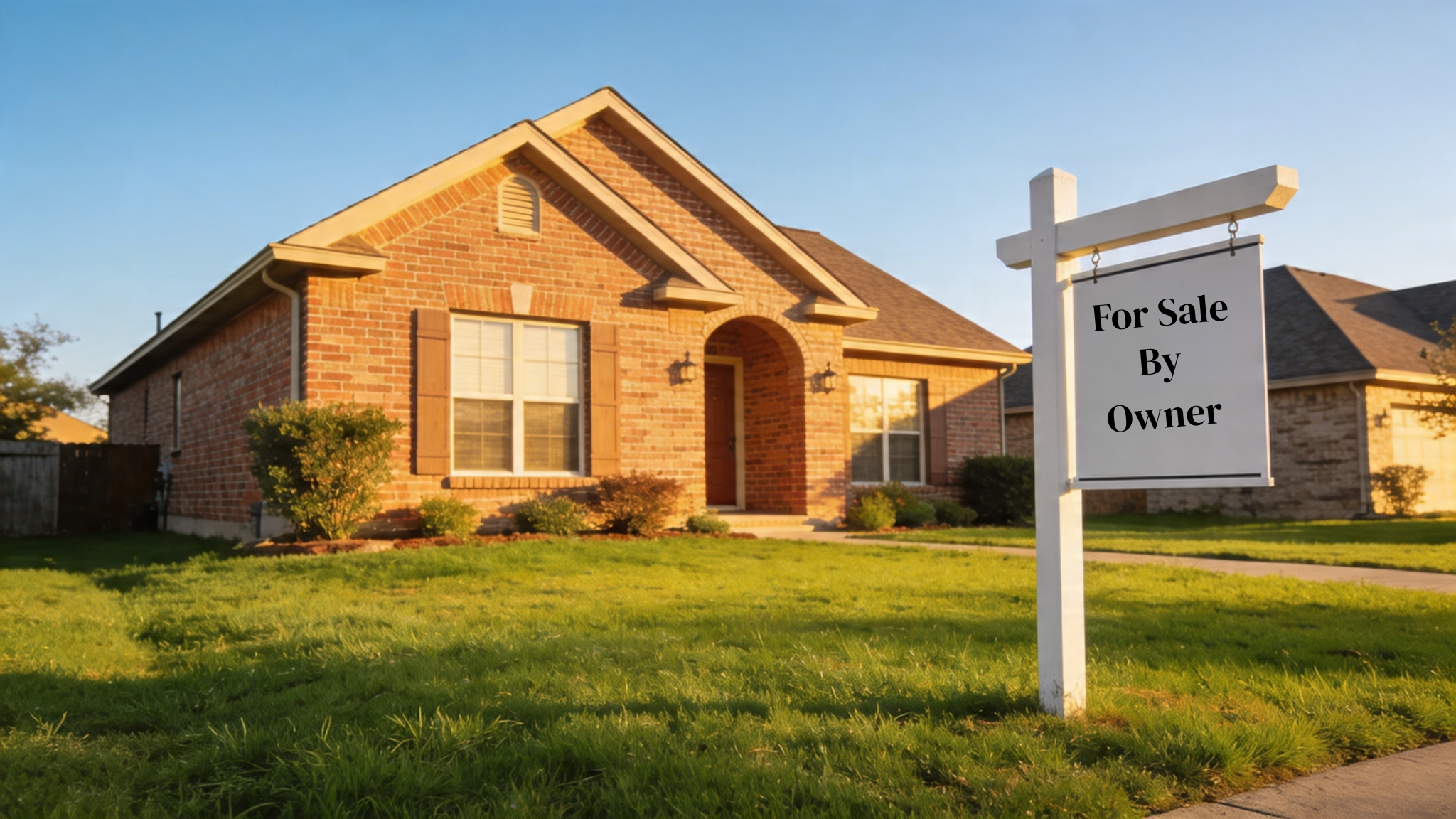
Texas homeowners have the full legal right to sell their own property without a real estate agent. Here is exactly what the law requires, what you are responsible for, and where a licensed broker remains necessary regardless of how you choose to sell.
Yes. It is completely legal to sell your home without a real estate agent in Texas. Texas law gives homeowners the full right to sell their own property.
According to the National Association of Realtors' 2025 Profile of Home Buyers and Sellers, FSBO sales accounted for 6% of all U.S. home transactions in 2023. That is a significant number of sellers who chose to manage their own sales, and in Texas, the law fully supports that decision. But what most sellers are actually missing is the understanding of what Texas requires once they decide to move forward.
What Texas Law Actually Says
Texas does not require a homeowner to hire an agent to sell their own property. The Texas Real Estate License Act (Texas Occupations Code Chapter 1101) governs who must be licensed to represent others in real estate transactions. When you sell your own home, you are acting on your own behalf, and you are not representing someone else. That is explicitly permitted, and the Texas Real Estate Commission (TREC) does not require sellers to hold a license to do it.
You will also find this right stated clearly in the Texas Administrative Code: "Acting as a principal, a person may purchase, sell, lease, or sublease real estate for profit without being licensed as a broker or sales agent." That means no license is required to sell your own house in Texas. Period.
The law is not what trips up most FSBO sellers. What trips them up is not knowing what they are required to do next. The real question is not "Can I legally sell my own house?" It is "Do I understand what Texas law requires of me once I do?"
What You Are Legally Required to Do as a Texas Seller
Even without an agent, Texas law places specific disclosures and documentation on you from the moment you list your home. Skipping any of these can give the buyer grounds to walk away from the deal or expose you to legal liability long after closing.
Here are the three legal requirements every Texas seller without an agent must understand before going live.
Section 5.008 of the Texas Property Code requires sellers of most residential properties to complete and deliver this form to the buyer before the contract is executed. The disclosure covers:
- Known defects and material conditions affecting the property
- The condition of the roof, foundation, plumbing, electrical, and HVAC systems
- Whether the home is in a flood zone or has experienced previous flooding
- HOA membership, fees, and any pending assessments or litigation
- Previous insurance claims and known environmental hazards
Delivering the form after the contract is signed does not satisfy the legal requirement. If you fail to provide it before execution, the buyer has the right to terminate the contract and recover their earnest money, even after the option period has ended. The current form is available at no cost from trec.texas.gov.
Texas law does not mandate that you use a specific contract form, but the TREC 1-4 Family Residential Contract is what every buyer, buyer's agent, and lender expects in a Texas residential transaction. Submitting a non-standard agreement creates friction with the buyer's agent and can raise flags with the buyer's lender before the deal even gets off the ground. Using the TREC-promulgated form eliminates that problem entirely.
Available for download from trec.texas.gov. Before you countersign any offer, you need to understand what you are agreeing to. The TREC contract covers:
- Purchase price, earnest money amount, and who holds it
- The option period, typically 3 to 5 days, during which the buyer can terminate for any reason by paying a negotiated option fee
- Financing and appraisal contingencies
- The closing date, possession terms, and what is conveyed with the property
- Repair amendment provisions triggered after the inspection
The Federal Fair Housing Act prohibits discrimination in the sale of residential property based on race, color, national origin, religion, sex, familial status, or disability. Texas law adds additional protected classes. These rules apply to every seller, with or without an agent, from the first day your home is marketed.
Your listing language, your showing policies, and your decisions about which offers to consider are all subject to fair housing requirements. Not having an agent does not create an exemption. It means no one is reviewing your compliance for you.
The MLS Question
A FSBO seller cannot list their home on the MLS directly, and this is where many sellers get confused.
The MLS is a cooperative database that only licensed, dues-paying member brokers can post listings to. In Texas, that means SABOR in San Antonio, HAR in Houston, ACTRIS in Austin, and NTREIS in Dallas-Fort Worth. Texas law does not prevent you from selling without an agent, but the MLS itself requires broker participation to submit a listing. Without that access, your home is invisible to the buyer's agents who are actively searching those databases every day.
This matters more than sellers expect. According to TREC's 2024 market data, the vast majority of Texas buyers work with a buyer's agent, and those agents find their inventory on the MLS, not on yard signs or Facebook Marketplace. A home that is not on the MLS is reaching a fraction of its potential buyer pool.
There are two realistic paths to MLS access without paying a full listing commission:
A licensed broker submits your listing to the MLS for a one-time upfront fee. In most cases that is where their involvement ends. Offers, negotiations, contract decisions, and disclosure questions fall entirely on you to handle.
Your listing is submitted through a licensed Texas broker. Aria builds a pricing analysis, breaks down offers in clear terms, guides you through disclosures, and tracks every contract deadline. A licensed broker reviews your listing for compliance and steps in at the moments that carry real financial risk.
A buyer's agent searching SABOR in San Antonio or NTREIS in Dallas sees a cooperating broker on a Waymark listing. That changes how the offer process begins and how seriously your listing is treated.
3 Misconceptions Texas Sellers Commonly Get Wrong
These come up in almost every conversation with sellers who are new to this process. Believing them can cost you time, money, or the deal itself.
You do not. Texas does not require a real estate attorney to close a residential transaction. Title companies handle the closing process, and that is how the overwhelming majority of Texas residential sales get closed. A seller may choose to consult an attorney on a specific legal question, but it is not a legal requirement for a standard home sale.
This is partially true, but only for homes that are not on the MLS. A listing submitted to ACTRIS in Austin or HAR in Houston through a licensed broker appears in agent searches just like any other property. Buyer's agents see a cooperating broker and a standard listing. The concern about being skipped over only applies to homes that never made it onto the MLS in the first place.
Not necessarily true. A service like Waymark means you have AI-powered guidance through every step, pricing analysis, offer breakdowns, deadline tracking, and disclosure support, plus a licensed broker who steps in at the moments that carry real financial risk. You make every decision. But you are not navigating it without any support.
Final Thought
For Texas sellers who want to sell without a listing agent and stay fully compliant with state law, the requirements are clear: understand your obligations under the Texas Property Code and Texas Occupations Code, complete the Seller's Disclosure Notice correctly, use TREC-promulgated forms, and get your home on the MLS through a licensed Texas broker.
Waymark is built around this structure, with flat fees starting at $699 and no listing commission at closing. Every listing is submitted through Marelli Properties, TREC License 639078, with broker review built in. Waymark serves sellers on SABOR in San Antonio, HAR in Houston, ACTRIS in Austin, and NTREIS in Dallas-Fort Worth.
Sell legally. Sell smart. Keep your commission.
Full MLS exposure through a licensed Texas broker. AI guidance from pricing to closing. Broker consultation when it matters. Flat fee from $699.